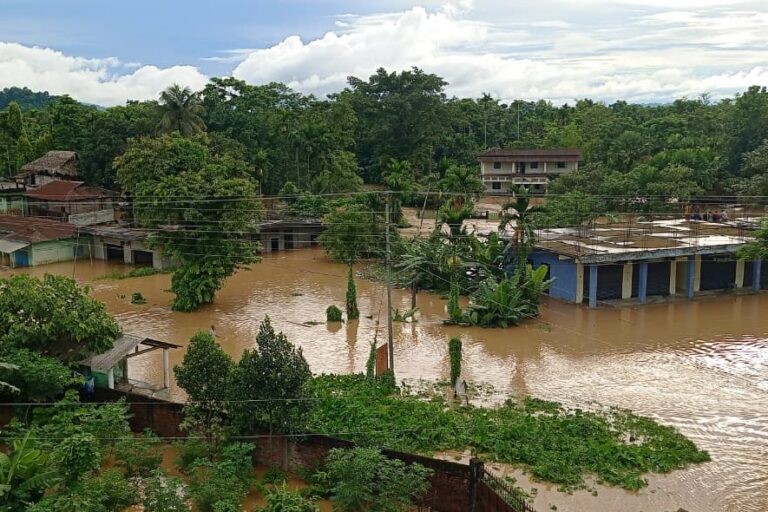
In Bangladesh, water is both a source of life and a recurring barrier to education. Seasonal floods and high waters can submerge roads, isolate villages and make schools inaccessible for weeks or months. For children living in flood-prone wetlands, particularly in Northwestern part of the country which covers the Rangpur and Rajshahi Divisions, continuing education becomes difficult not because they lack the desire to learn, but because the route to school disappears beneath the water.
In response, Architect Mohammed Rezwan founded Shidhulai Swanirvar Sangstha (Shidulai) in 1998, pioneering solar-powered floating schools that travel by boat to students’ doorsteps. These specially built school boats - flat-bottomed for shallow waterways and fitted with multi-layer roofs and windows for rain protection and ventilation, bring a full classroom to remote villages. Each Shidhulai school boat carries benches, textbooks, a library, a computer and solar panels (500Wp-2kWp) powering lights and devices. Approximately 30-35 students (50% girls) attend each session, receiving free tuition and materials before being dropped back home after class.
Shidhulai‘s solar-powered floating schools navigate village waterways, bringing mobile classrooms to children unable to reach regular schools. The boat’s rugged design lets them operate year-round on shallow floodwaters. Solar arrays on the roofs charge batteries that run LED lighting and a computer lab, powering education even off-grid. This innovative design covers about two square kilometers of riverbank area each day.
Shidhulai’s scale and reach have grown significantly. Today it operates dozens of boats (around 54 solar -powered boats) serving on the order of 90,000-100,000 people in the Chalnbeel wetland region. About 20 of these vessels are dedicated floating schools, each visiting multiple villages daily to hold several class sessions. Other boats in the fleet function as mobile libraries, with books, printers and clinics (5 boats providing free care) and agriculture extension centers (5 boats for training local farmers). In essence, Shidhulai has turned Bangladesh’s waterways into lifelines of education and services.
Floating schools have demonstrated benefits in Bangladesh and elsewhere. By bringing education to students, Shidhulai boats have increased attendance and cut dropouts. Children who otherwise would stay at home or work, attend regular classes. In BRAC’s similar Shikka Tari school boats, enrollments rose sharply by 2017, there were 13,600 students (59% girls) in 500 boats and students achieved 99% pass rates on primary exams. Shidhuai’s model likewise reduces barriers of cost, distance and safety. Evaluations note that providing free “nearby schooling prevents children from being influenced by bad company” and lets them focus on learning. Over time, these programs improve literacy and empower communities: dropout rates fall, repeat attendance and parental trust improves and local economies gain from job opportunities.
Floating schools offer a sustainable indigenous solution to climate disruption. By matching the environment (schools float when land is flooded), they ensure education remains unsinkable. Experts emphasize that this community-driven model can be replicated in other flood-prone regions. Indeed, similar floating schools now operate in Vietnam, Nigeria and the Philippines. The Shidhulai approach is often cited as a case study in climate resilience and inclusive education.
Shidhulai’s floating schools have kept children learning through Bangladesh's floods, but they have persistent challenges. Remote floating schools require teachers willing to live on boats. High workload (For example, one boat has three class shifts daily) and isolation can drive turnover. Additionally floating schools are expensive to maintain because the organisation has to maintain boats, solar equipment, teaching materials, computers and other infrastructure. Unlike a normal school building, a schoolboat requires regular maintenance and operational costs. Shidhulai has historically depended heavily on donor and external support, which can make long-term expansion difficult. If funding decreases, fewer boats may be able to operate or services may have to be reduced.
The boats are designed to operate during floods, but this does not mean they are unaffected by extreme weather. Storms, strong currents, heavy rainfall and rapidly changing water levels can make navigation difficult or unsafe. This creates an important limitation. A floating school can overcome ordinary flooding, but exceptionally severe weather can still interrupt education. Thus, climate adaptation should not assume that one solution can withstand every climate hazard. Floating schools need disaster preparedness, safe operating procedures and alternative arrangements for extreme conditions.
A mobile classroom can solve the problem of access, but access does not automatically guarantee high-quality education. Students may have different ages and learning levels, while the classroom has limited space and resources compared with a conventional school. Maintaining consistent curricula, assessment and learning outcomes can therefore be challenging. One boat can only accommodate a limited number of students at a time. Even if the model works extremely well in one community, expanding it to thousands of flood-affected communities would require more teachers, more boats, more funding, more maintenance facilities, more educational materials and stronger organizational capacity. A successful local innovation cannot be automatically scaled up. Replication requires government support, financing and adaptation to local conditions.
The lesson from Shidhuai is not that every flood-prone community needs a school on a boat. It is that climate resilience begins by understanding the realities of the people most affected. By adapting education to environment rather than waiting for the environment to change, Shidhulai shows that solutions can be local, flexible and community-driven. Yet, its experience also reminds us that innovation must be supported by sustainable funding, trained teachers, maintenance and strong public infrastructure. Ultimately, resilience is not about building against change, but about ensuring that essential opportunities, especially education, can continue despite it.
When the water rises, the lesson is not to stop learning, it is to learn how to adapt.
About the author
Deiphi Kurbah is an Undergraduate Student from the Department of Public Policy, Political Science and Media Studies, Mount Carmel (Deemed to be) University, Bengaluru.